Back Pain Coventry & Birmingham

People do not realize how much they move their neck, until they are unable to do so. The neck has the least amount of muscular stabilization to support and move your 12 - 16 pound head, which makes it very susceptible to injury. It doesn't take much force to disrupt that fine balance.

The spinal cord passes through a space in the vertebrae sending nerve impulses to every part of the body. Between each pair of cervical vertebrae, the spinal cord sends bundles of nerves that pass down the arms and to the upper back, and if your arm is hurting, it may be a problem in the neck! Symptoms in the arms can include numbness, tingling, cold, aching, and "pins and needles".

The neck can also contribute to headaches, muscle spasms in the shoulders and upper back, ringing ears, otitis media (inflammation in the middle ear, temporomandibular joint dysfunction (TMJ or jaw joint). Dysfunction of the neck also causes restricted range of motion and chronic tightness in the upper back.

Causes of Neck and Upper Back Pain

Neck and upper back pain is caused by a combination of factors, including injury, poor posture, stress, and disc problems.

Injuries

The most common injury to the neck is a whiplash injury. Whiplash is caused by a sudden movement of the head, (see our Whiplash section)

Much more common causes of neck pain, and headaches are poor posture. It's easy to get into bad posture habits, can eventually lead to pain and headaches. The rule is simple: keep your neck in a "neutral" position whenever possible. Don't bend or hunch your neck forward for extended periods. Also, do not to sit in one position for extended period of time. If you must sit for an extended period, make sure your posture is good: Keep your head in a neutral position, make sure your back is always supported, keep your knees slightly lower than your hips.

Stress

When people become stressed, they unconsciously contract their muscles. Particular, the muscles in their back. This 'Muscle guarding' or Defense posture is a response designed to guard against injury. Muscle guarding occurs whenever we become emotionally stressed. The areas most affected are the muscles of the neck, upper back and low back.

Disc Herniations

Discs in your neck may herniated or bulge and put pressure on the nerves that lead from the spine into your shoulders, arms and hands. Although cervical discs do not bulge nearly as often as lumbar discs do, they occasionally can still get damaged, especially when damage sustained from a whiplash injury. (See our Cold Laser Therapy Section under Inflammatory conditions.)

Lower Back Pain Treatment & Physiotherapy Coventry, Warwickshire

Eighty percent of people suffer from back pain at some point in their lives. Back pain is the second most common reason for visits to the doctors. In fact, it is estimated that low back pain affects more than half of the adult population each year and more than 15% of all people experience frequent bouts of low back pain.

The susceptibility of the low back to injury and pain is due to the fact that the low back, like the neck, is an unstable part of the spine, unlike the thoracic spine, which is supported by the rib cage. This instability allows us to have a great deal of mobility to touch our toes, tie our shoes or pick something up from ground level, but at the cost of increased risk of injury.

The low back can withstand tremendous forces as long as it is healthy and functioning correctly. However, if the low back is out of alignment or has weakened supporting muscles, something as simple as putting a bag or suit case in and out of the boot of a car, picking something up off the floor, or simply bending down can cause a low back injury.

Studies have shown that when back pain is not treated, it may go away temporarily, and is very to likely return. The importance to take low back pain seriously can not be stressed enough. The professional chiropractic care is one of the best ways to care for your back.

The Causes of Low Back Pain

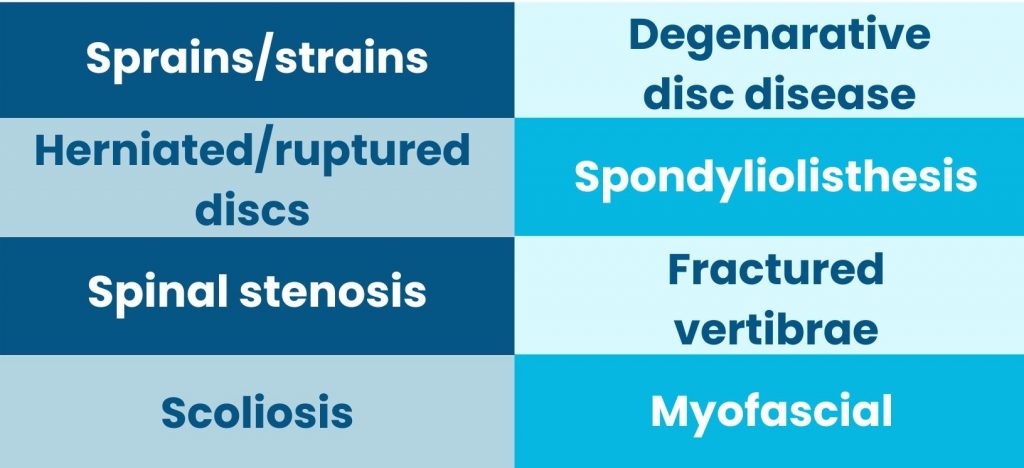
Sprained ligaments, strained muscles, ruptured disks, trigger points and inflamed joints are the many of different conditions that can result in low back pain. While sports injuries or accidents can lead to an injury and pain, sometimes even the simplest movements, like picking up a pencil from the floor, can have painful results. In addition, conditions such as poor posture, stress, arthritis, kidney stones and kidney infections, can be the cause of low back pain.

There may be many other things that can cause low back pain, and some of those things can be serious if left untreated. Chiropractors are the experts in diagnosing the cause and determining a proper course of treatment for low back pain. Following are some of the most common causes.

Subluxations

When a disruption in the normal movement or position of the vertebrae occurs it results in pain and inflammation. In the lumbar spine these occur at the transition between the lower spine and the sacrum. Subluxations can lead to debilitating low back pain, however, subluxations are easily treatable and there is often a significant reduction in pain experienced almost immediately after treatment.

Disc Herniations

A herniated disc does not automatically mean that you may suffer from low back pain. In one study almost 60% of all adults had at least one bulging or herniated disc, even though they did not experienced any back pain. However, herniated discs can be a source of severe and debilitating pain, which may radiate to other areas of the body. Unfortunately, when a disc herniates, they rarely, completely heal. Further deterioration can be avoided through chiropractic care, but a complete recovery is less common.

Sprains, Strains and Spasms

Sprains strains and spasms, are the most common source of low back pain. Overworking the muscles or ligaments of the low back may lead to tears in the tissues, which become painful, swollen and may even ache, with a tightening to the area affected.

Stress

When you become stressed, your body responds by increasing the levels of stress hormones leading to the rise of blood pressure and heart rate and tightening up of your muscles. By becoming stressed all the time your muscles will become weak and painful loaded with trigger points.

Chiropractic treatment for the low back has been repeatedly shown to be the most effective treatment for low back pain. Major studies have shown that chiropractic treatment is more effective, and has better long-term outcomes than any other treatment. Why? This makes sense is because chiropractic treatment is the only method of treatment that works to re-establish normal vertebral motion and position in the spine. All other treatments, such as muscle relaxants and pain killers, will only decrease the symptoms of the problem and do not correct the problem itself.

Chiropractic treatment for low back pain is normally straight forward, and simply a matter of adjusting the lower lumbar vertebrae and pelvis to re-establish normal motion and position of your bones and joints. (See our Cold Laser Therapy Section under Inflammatory conditions.)

Sciatica Chiropractic Treatment & Physiotherapy Coventry, Warwickshire

The sciatic nerve is the longest nerve in your body. It runs from your pelvis, through your hip area and buttocks and down each leg. The sciatic nerve branches into smaller nerves as it travels down the legs providing feeling to your thighs, legs, and feet as well as controlling many of the muscles in your lower legs. The term sciatica refers to pain that radiates along the path of this nerve.

What causes Sciatica?

Sciatica is actually a sign that you have an underlying problem putting pressure on a nerve in your lower back. The most common cause of this nerve compression is a bulging or herniated lumbar disc. Piriformis syndrome is another common cause of sciatica. The piriformis is a muscle that lies directly over the sciatic nerve. If this muscle becomes tight or if you have a spasm in this muscle, it puts pressure directly on the sciatic nerve. Occasionally, sciatic pain in men is caused by sitting on a wallet.

How do I know if I have sciatica?

Pain that radiates from your lower (lumbar) spine to your buttock and down the back of your leg is the hallmark of sciatica. Sciatica may be accompanied by numbness, tingling, and muscle weakness in the affected leg. This pain can vary widely, from a mild ache to a sharp, burning sensation or excruciating discomfort. Sometimes it may feel like a jolt or electric shock. Sciatic pain often starts gradually and intensifies over time. It's likely to be worse when you sit, cough or sneeze.

How is Sciatica Treated?

The vast majority of the time, sciatic pain can be relieved through a combination of stretches, deep tissue massage of the piriformis muscle and chiropractic care. Occasionally, in cases where chronic spasm of the low back or piriformis muscles is causing the sciatic pain, it may be necessary to do a procedure called a trigger point injection, where a medical pain specialist injects a small amount of anesthetic directly into a spasmed muscle to break the spasm cycle. (See our Cold Laser Therapy Section under Inflammatory conditions.)

Complementary and alternative medicine

Complementary and alternative medicine (CAM) refers to medical and health care systems, practices, and treatments that aren't currently part of conventional medicine, i.e. the care you receive in your primary care doctor's surgery. Many of these therapies and treatments are being studied intensely, and some have proved to help alleviate back pain.

Chiropractic

Chiropractic is a system of treatments which is based on the philosophy that restricted movement in the spine may lead to reduced function and pain.

Spinal adjustment (manipulation) is one form of therapy chiropractors use to treat restricted spinal mobility. The goal is to restore spinal movement and, as a result, improve function and decrease pain.

Chiropractors manipulate the spine from different positions using varying degrees of force. Manipulation doesn't need to be forceful to be effective. Chiropractors may also use massage and stretching to relax muscles that are shortened or in spasm.

Some studies done on spinal manipulation have found it to be as effective and safe as standard treatments, especially for initial pain relief, though the optimal number of treatments depends on individual case.

Recent research has shown that 75% to 80% percent of patients suffering with chronic sciatica benefit from chiropractic treatment

Massage

To conduct an objective clinical trial in massage can be difficult due to variances in practitioners and in massage types however, studies that have been conducted suggest that massage may ease low back pain symptoms by reducing muscle spasm.

The greatest risk factors for sciatica include:

Age

Age related changes in the spine are a common cause of sciatica. You're likely to have some deterioration in the disks in your back by the time you're in your late 20s, and most people who develop herniated disks are in their early 30s and 40s and Previous injuries from sport and work related, activity are also common factors.

Occupation

jobs that requires you to twist your back, and carry heavy loads, driving a motor vehicle for extended periods makes you more prone to develop sciatica.

Prolonged sitting

People who sit for prolonged periods or have a sedentary lifestyle are more likely to develop sciatica than people with active lifestyle.

Diabetes.

This condition, which affects the way your body uses blood sugar, increases your risk of nerve damage.

When to seek medical advice

Seek immediate medical treatment if:

  • You experience sudden, severe pain in your low back or ether or both legs and numbness or muscle weakness in ether or both of the legs.
  • The pain follows a injury, from a traffic or work related accident.
  • You have trouble controlling your bowels or bladder.

Screening and diagnosis of sciatica

To help diagnose sciatica and pinpoint which nerves, if any, are affected, your chiropractor will ask about your medical history and perform a thorough physical exam, paying special attention to your spine and legs.

You're also likely to have some basic tests that check your muscle strength and reflexes. For example, you may be asked to walk on your toes or heels, and, while lying on your back, lift your legs one at a time straight in the air. Pain that results from sciatica will usually become worse during this examination.

If your pain lasts longer than four weeks or is very severe, or you have another serious condition such as cancer, you may have one or more imaging tests to help identity why the sciatic nerve is compressed and to rule out other causes for your symptoms.

These tests include:

Spinal X-ray.

Because ordinary X-rays can't detect herniated disk problems or nerve damage, they're not usually helpful for pinpointing the cause of sciatica. A spinal X-ray can show most cancers affecting the bony structures of the spine, narrowed disks and spondylolisthesis, however, and can help rule out other causes of nerve root impingement.

Magnetic resonance imaging (MRI).

This is probably the most sensitive test for assessing sciatic nerve pain. Instead of X-rays, MRI uses a powerful magnet and radio waves to produce cross-sectional images of your back. The test can detect damage to your disks and ligaments as well as the presence of tumors. MRI is noninvasive and has no harmful side effects.

During the test, you lie on a movable table inside the MRI machine, which is essentially a large magnet. If you have a hard time lying still for the required period of time or you're anxious about the enclosed space, you may be given a sedative. Some MRI units may be wider, shorter or open on all sides, which may be more comfortable for you, although the quality of images taken with these systems may vary.

Computerized tomography (CT) scan

This test uses a narrow beam of radiation to produce detailed, cross-sectional images of your body. When CT is used to image the spine, you may have a contrast dye injected into your spinal canal before the X-rays are taken a procedure called a CT myelogram. The dye then circulates around your spinal cord and spinal nerves, which appear white on the scan.

Complications of sciatica

Although people recover from sciatica, sciatica can potentially cause permanent nerve damage. Depending on what's causing the nerve to be compressed, other complications may occur, They included:

  • Loss of feeling, may affected one or both or legs.
  • Loss of movement may affected one or both legs.
  • Loss of bowel or bladder function.

Opening Hours

  • Mon 8.00am - 7.30pm
  • Tue 8.00am - 7.30pm
  • Wed 8.00am - 7.30pm
  • Thu 8.00am - 7.30pm
  • Fri 8.00am - 6.00pm
  • Sat 9.00am - 1.00pm

Latest News & Articles

Severe Neck Pain Causes Warwickshire

Due to an inherent weakness in the area, neck pain can be one of the...

2 September 2010 | Read Article »

Cure Upper Back Pain Warwickshire

This latest news post discusses the treatments the Central Chiropractic Clinic provide to help cure...

18 August 2010 | Read Article »